Blog #206: Shakespeare and Neurodiversity: MacBeth

“Double, double, toil and trouble, fire burn and cauldron bubble! By the pricking of my thumbs, something wicked this way comes!”
…
Yes, that quote may seem like something out of a creepy Dr. Seuss book, but it’s actually from another of Shakespeare’s greatest works. For this blog, I continue my segment on “Shakespeare and Neurodiversity” by covering MacBeth, the story of a Scottish snake in the grass who kills the king and takes his place. Unfortunately, there are grave consequences with what is done that results in a really graphic ending.
…

Jon Finch as MacBeth in “MacBeth” (1971)
MacBeth is a play that demonstrates what happens with our ambition and desires if we don’t have the patience to maintain that ambition and desire properly. For neurodiverse individuals, we all have ambition and desire that we would want to have without the use of patience. Now, take note that MacBeth already has a cushy position as a general in the Scottish army, but he wants more and will do anything to obtain that specific goal, including killing the king, Duncan.
The chances of obtaining a goal and maintaining it can range from a variety of ways that is really up to us. If neurodiverse and special education students should learn anything from MacBeth, its patience…patience…patience.
…
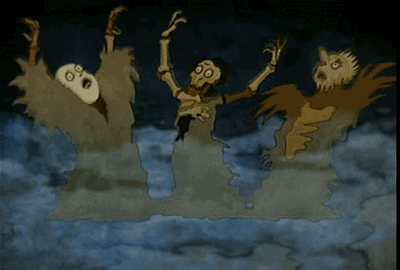
The Three Witches as depicted from BBC Shakespeare Animated: MacBeth
Now another factor that MacBeth can teach neurodiverse and special education students is the fact that there are false prophets in the world, individuals not having your own best interests at heart. This is represented by the three witches in “MacBeth” who claim that MacBeth will become king of Scotland, which he ultimately does, but MacBeth later plays a reverse move on them by saying that he will not beware of the Thane of Fife, MacDuff.
Unfortunately, a lot of neurodiverse/disabled individuals are taken advantage of by a lot of these so called “prophets” to the point where the consequences can be life threatening.
We are seeing this a lot on social media and in society as a whole and I think MacBeth can teach us a thing or two about false ideas and prophets. Pretend for a moment that the three witches are named Facebook, Twitter and TikTok.
Just because you see something on any of those websites that you think you can obtain, doesn’t mean it will come true. As an aspiring self-advocate, writer and public speaker, I have often put myself into situations where I have dealt with false prophets and ideals that never came to pass. Now, as a business owner, I know to avoid them at all costs.
…

Brian Cox as MacBeth in “BBC Shakespeare Animated: MacBeth”
Finally, “MacBeth” also teaches us that there always a small chance we can be rooting for the antagonist to save the day. This is what is known as an anti-hero. Neurodiverse and Special Education students tend to forget that not all heroes are good and not all villains are evil. “MacBeth” clearly demonstrates that in the form of MacBeth’s archenemy, MacDuff.

Dan O’Herliy as MacDuff in “MacBeth” (1948)
Now, MacDuff’s motivation to kill MacBeth was quite clear: he lost his families, servants and property to MacBeth and wants revenge, but look at the situation clearly. MacDuff is in reality one of the greatest heroes Scotland has ever known and his actions in killing MacBeth are justified.
We see a lot of anti-heroes in film and television, but we don’t really understand why they are anti-heroes at first. When you watch MacDuff kill MacBeth, don’t assume that he did it for the hell of it. Instead, try to see the situation from MacDuff’s point of view.
Special Education students who are neurodiverse tend to be emotionally connected to a character or form of media to the point where it gets bad for their mental health. Believe me, I know as I have been down that path myself.
…
In conclusion, “MacBeth” is a play that can teach us more than just patience, false prophets and anti-heroes. It can teach us what happens when we let the power get to our heads and as a result, we are walking over everybody around us.
You know, you’d be surprised at how many “MacBeth’s” there are in the world right now, using their power and authority to walk over people less important to them. You’d be equally surprised as to how many “MacDuff’s” are waiting to assume the role of anti-hero and believe me, there are a lot of them.
…
For film versions of “MacBeth” for both Special Education and General English Teachers to show their students, I can only recommend two versions:
A. “MacBeth” (1948): If you want to go the classic route, then I would recommend the 1948 Orson Welles version of “MacBeth.” I’ve yet to see this film, but it’s got a great list of actors including Welles, Jeanette Nolan, Dan O’Herilhy, Roddy McDowall and Alan Napier.
….
B. “MacBeth” (1971) I gotta be honest, even though I never saw this version, this version of “MacBeth” by Roman Polanski seems a little, I don’t know, too updated to say the least. Plus, the cast isn’t really all that well known to me. But, if you don’t want to bore your students, then go ahead and show this to them.
…
Catch you all later!!


Comments