Blog #111: Why George Banks from “Mary Poppins” is an Example of Not Being Mean, Just Be
- Jeffrey Snyder

- Nov 8, 2021
- 3 min read

David Tomlinson as George Banks in Walt Disney’s “Mary Poppins” (1964)
A couple of blogs back, I talked about why “Morris the Midget Moose” from 1950 strongly represented neurodiversity and disability in general. But there is another character that represents neurodiversity more than disability in a way and it’s a trap that many neurodiverse individuals fall into: being misled in the wrong direction.
…
That character is George Banks from Walt Disney’s “Mary Poppins” (1964) and portrayed by David Tomlinson (1917-2000). Now George is a character that has been described as a company man, who takes his job seriously to the point of being neglectful towards his own children, Jane and Michael.
Like George, I take whatever I do seriously, such as my advocacy. It’s my career choice and calling in life, but there are times where I need to slam down on the brakes and slow down. George doesn’t do that and it’s up to a magical nanny to save his life before it’s too late.
…

George Banks and Bert (Dick Van Dyke) in the classic “A Man Has Dreams” scene from Walt Disney’s “Mary Poppins” (1964).
We high functioning autistic individuals are very passionate about what we do in life. You can throw yourself into your work and sometimes never come out of it. But it’s always important to take that step back if you have to.
…
George does not do that and it ends up driving his family apart. But would you classify him as a villain? Absolutely not! It may seem like George is the antagonist of the film, but he really isn’t. That honor belongs to Mr. Dawes Sr, who sees George and his father before him as cogs in the wheel, which is really unfortunate.
…

George Banks’ savior, Mary Poppins, played by Julie Andrews in Walt Disney’s “Mary Poppins” (1964).
Neurodiverse individuals who have a job that they earn money for will oftentimes be driven to that job, but they end doing it for someone who doesn’t really care for them and that is the true villain, not the individual themselves.
When it comes to finding a job and following your passion, it’s really important to find that common ground even though there may be a sacrifice on your part. Until Mary Poppins came around, George had that one road to follow and it was a very bad road. She spends the entire movie not only trying to help Jane and Michael understand their father, but also to make him snap out of what he was doing.
…
This, of course, leads up to the infamous “run on the bank” scene in the film where Michael ends up causing a run that later exposes George to what he had been putting aside for a long time: his true purpose in life.
George of course gets fired, but guess what? He gets that cold splash of reality that his family and his personal life are more important than his profession. You can replace a job, but you can’t replace a life.

Portrait of American puppeteer and film & television director Jim Henson (1936 – 1990) as he poses with one of his creations, Kermit the Frog, New York, New York, January 4, 1988. Henson holds open a copy of the book, ‘My First Muppet Dictionary.’ (Photo by Michel Delsol/Getty Images)
Some people have unfortunately worked themselves to death like Jim Henson, who despite his impact on the world, never had time to look after his own health and ended up dying of bacterial pneumonia as a result.
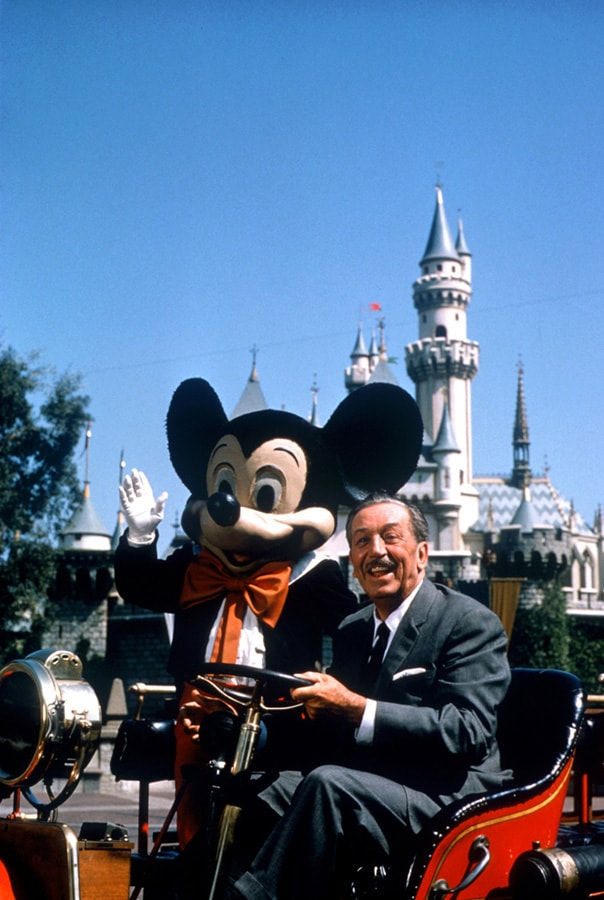
Walt Disney (1901-1966) in the very last photo taken of him with Mickey Mouse at Disneyland just before his death.
Even Walt Disney himself worked himself to death to a degree, using smoking to cope with the demands of running his empire.
…
What may be hard for neurodiverse, disabled or even neurotypical individuals to understand is that setting time aside for yourself and your personal life can put a dent in your passions. But while following your passion is important, so are those around you.
…
When George looks down at the tuppence at the climax of “Mary Poppins,” he finally sees the light that what he was doing was wrong and that he was going to change for the better.
That’s why “Let’s Go Fly a Kite” at the end of the film is such a powerful number to conclude because it is an example of someone overcoming the demons controlling them and put their true intentions first and foremost.
…
Sadly, though while George Banks overcame his demons, his son Michael would later fall into the same trap many years later but for an entirely different reason of which I will talk about in my next blog!!
…
Catch you all later!!


Comments